বৌ-ঠাকুরাণীর হাট
Bou-Thakuranir Haat — Tagore's first Bengali novel and its translations
📦 Repository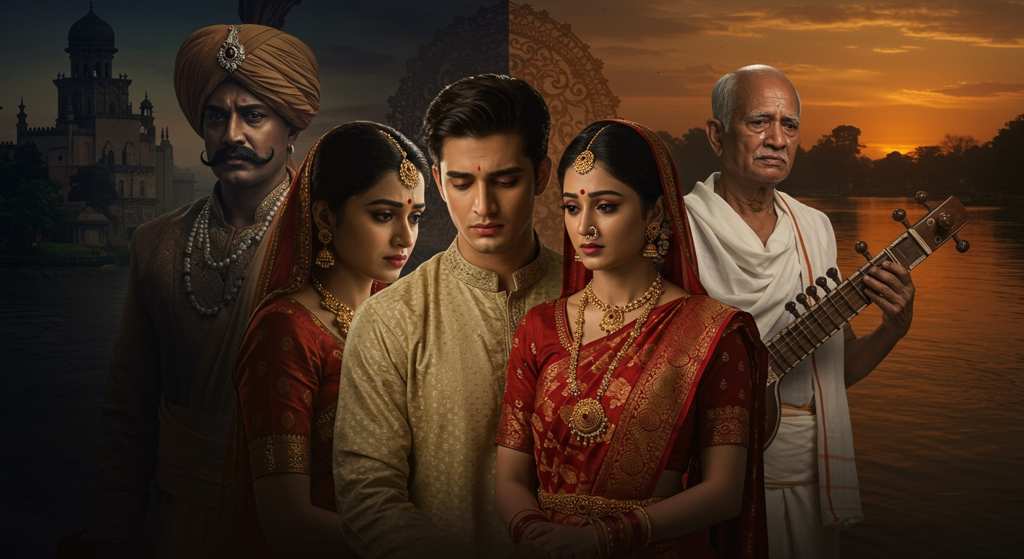
The original text is written in classical (Sadhu) Bengali — an older literary form distinct from modern spoken Bengali. All translations on this site (modern Bengali, Hindi, English, and Japanese) are machine-generated by Gemini 2.5 Pro and have not been reviewed or corrected by a human translator. Errors and mistranslations are present throughout; these pages are provided as-is for reference and study purposes only. The original text is in the public domain, and all translations, summaries, and other derived works in this repository are dedicated to the public domain under CC0 1.0.
Synopsis
Set against medieval Bengali kingdoms, the story follows Udayaditya, eldest son of King Pratapaditya, and his sister Viva. Tensions between father and son lead Pratapaditya to imprison Udayaditya, who escapes with the help of his grandfather Vasant Ray — prompting Pratapaditya to have Vasant Ray killed in retaliation. Also central to the story is Udayaditya's wife Surma, admired for her intelligence and devotion, who is undermined by the royal family. The novel explores family betrayal, revenge, and the quest for power, and its title comes from a market named after Viva that appears later in the story.
Background
Published in 1882, this is Rabindranath Tagore's first novel, written when he was 22. It is a historical novella based on the real rivalry between King Pratapaditya of Jessore and the zamindar Ramachandra Ray of Chandradwip (present-day Barisal). Tagore later reworked the same material into his play Prayoshchitto (1909), which he revised again as Paritran (1929), and the novel was adapted into a film in 1953. The zamindar house at Sreepur, built for the family said to have inspired the character Surma, still stands in ruins today. The title comes from a market named after the character Bou-Thakurani (a princess/queen figure) in the story.
Reading the Chapters
Each chapter can be read in five languages via the tab switcher: the classical original, Bengali, Hindi, English, and Japanese. Use the sidebar to jump to any chapter. A chapter summary page is also available per language (see the sidebar), listing a short summary of every chapter on a single page.
QA List
RAG evaluation questions (25 single-passage + 25 cross-reference) generated from the English translation, with a Japanese counterpart. Each question links to the chapter(s) it draws on.
Docs
Reference documents analyzing the novel's language and structure:
- Bengali Language Analysis — an overview of Shadhu Bhasha (the classical literary style used in the original) versus Cholito Bhasha (modern colloquial Bengali).
- Close Reading: Shadhu vs. Modern Bengali (Ch.1) — a line-by-line comparison of Chapter 1's classical Bengali against a modern rendering.
- Story Flow Diagram — the main character relationships and plot sequence as diagrams.